
Search Florida Unclaimed Money
Florida holds billions in unclaimed money. The funds come from old bank accounts, uncashed checks, and insurance payouts that lost touch with their owners. The Florida Department of Financial Services runs the state's unclaimed property program and keeps a free database anyone can search. One in five Floridians has unclaimed funds sitting in this system right now. County Clerks of Court also hold money from court cases, tax deed sales, and foreclosure surplus across all 67 counties. You can search at no cost. Look online, call by phone, or send a request by mail to find unclaimed money in Florida.
Florida Unclaimed Money Quick Facts
How to Search Florida Unclaimed Money
The state runs a free search tool at fltreasurehunt.gov, the main site for Florida's Division of Unclaimed Property. The Department of Financial Services manages the whole program. You can look up accounts held in the name of any person or business. The site works any time of day. It costs nothing. Start by typing your full name and checking for matches. Use your last name first. Try maiden names, married names, and nicknames too. One in five Floridians has unclaimed funds from a forgotten financial account, so it pays to run more than one search for unclaimed money in Florida.
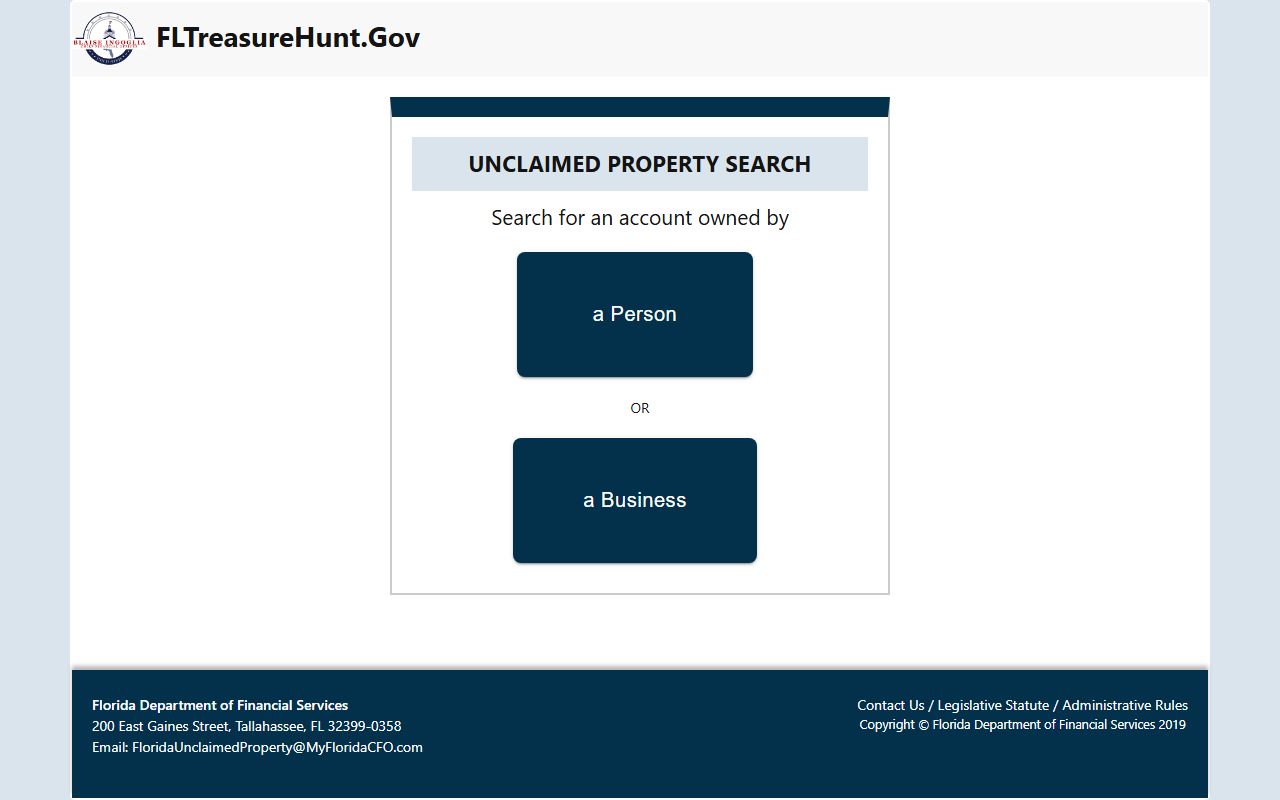
The claim search page is where you type in a name and check for unclaimed money. You can search for accounts held by a person or a business. Results show up fast. If you see a match, the site walks you through how to file a claim. The whole process is free and you can do it from home. Florida's unclaimed property database covers all funds that have been turned over to the state by banks, insurance firms, and other holders. It includes dormant bank accounts, stocks, bonds, uncashed checks, insurance proceeds, safe deposit box contents, and credit balances from across the state.
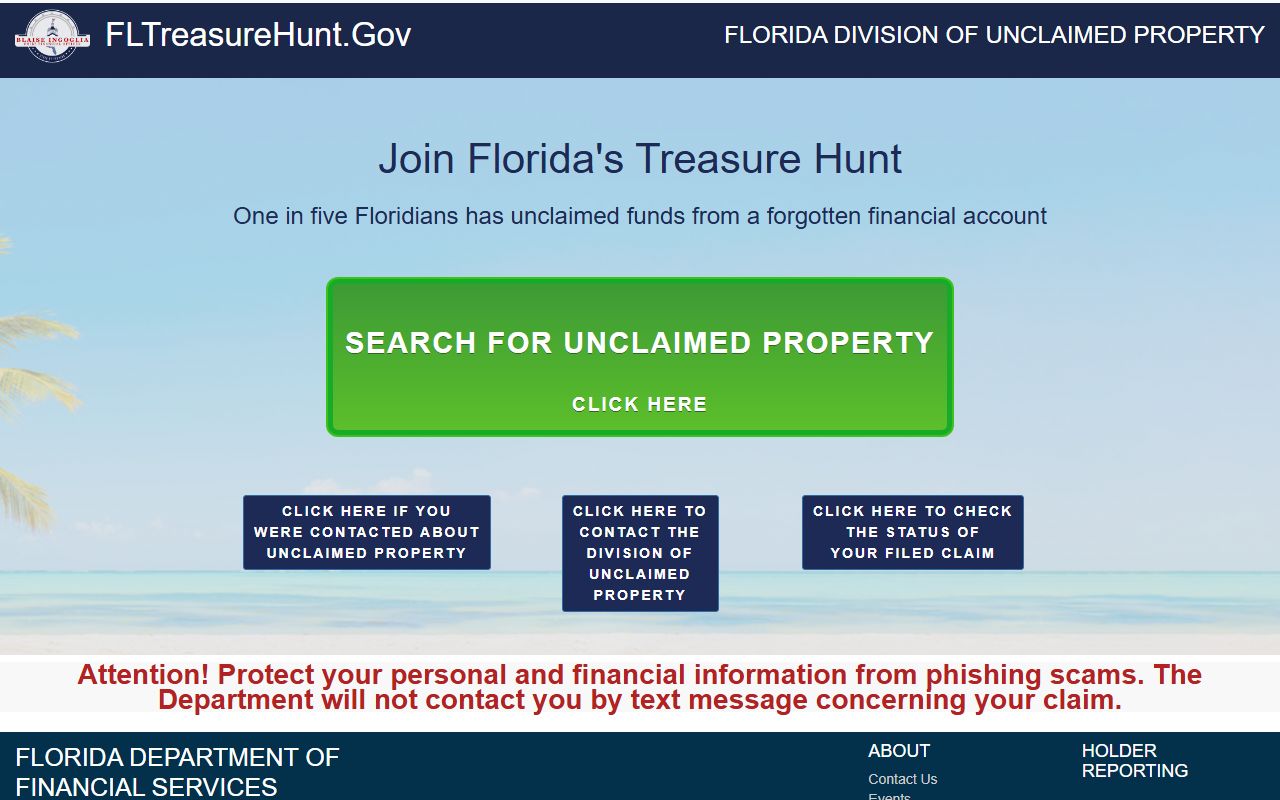
The screenshot above shows the Florida Treasure Hunt homepage where you begin your search for unclaimed money. The site warns users to watch for phishing scams. The Department will not contact you by text about a claim. Always start from the official site when you search for unclaimed money in Florida.
You can also use MissingMoney.com for a multi-state lookup. This site is backed by the National Association of State Treasurers and covers most US states plus parts of Canada. About 1 in 7 people across the country have unclaimed property. The average claim value is $2,080 based on their data. Search every state where you have lived or done business to check for unclaimed money beyond Florida.
What Is Unclaimed Property in Florida
Unclaimed property is any financial asset that is unknown, lost, or left idle by its owner. The most common types are dormant bank accounts, unclaimed insurance proceeds, stocks, dividends, uncashed checks, deposits, credit balances, and refunds. Safe deposit box contents from banks also count. When a holder like a bank or insurance company cannot find the owner after a set time, the asset gets turned over to the state. Under Chapter 717 of the Florida Statutes, businesses must try to find the owner first. When those efforts fail, the holder reports the property and the owner's name, last known address, and other details to the Department of Financial Services.
Florida's unclaimed property program makes all these accounts available in a free, searchable database. The state never takes legal ownership of the funds. It acts as custodian until the rightful owner comes forward. There is no time limit on claims. Account owners, or their heirs, can get their money back at any time. It is always free. Unclaimed funds get deposited into the State School Fund and support public schools in Florida, but the full amount can always be claimed by the owner.
The FAQ page at fltreasurehunt.gov answers common questions about unclaimed money in Florida. It covers how to search, what documents you need, and how long it takes to get your money back. The page is a good starting point if you are new to the process.
Common Types of Unclaimed Money
Florida holds many kinds of unclaimed property. The type depends on where the funds came from and who held them last. Each type has its own waiting period before it gets turned over to the state. Most general property becomes unclaimed after five years of no contact with the owner.
Some of the most common forms of unclaimed money in Florida include:
- Dormant bank accounts and savings deposits
- Uncashed checks from employers, vendors, or the government
- Life insurance benefits and annuity payments
- Stocks, bonds, and dividend payments
- Refunds and credit balances from utilities or businesses
- Safe deposit box contents from financial institutions
- Court registry funds, tax deed surplus, and foreclosure surplus held by county clerks
Wages have a shorter waiting period. Under Section 717.115 of the Florida Statutes, uncashed payroll checks become unclaimed after just one year. Safe deposit box contents have a three-year period under Section 717.116. Traveler's checks go unclaimed after 15 years, and money orders after seven years. Most bank deposits and insurance proceeds follow the standard five-year rule in Florida. These time frames give holders a chance to find owners before turning the money over to the state.
Florida Unclaimed Property Laws
The Florida Disposition of Unclaimed Property Act sits in Chapter 717 of the Florida Statutes. This law sets the rules for when property becomes unclaimed, how holders must report it, and how owners can get it back. Section 717.102 says any intangible personal property held by a business or financial group that has stayed unclaimed for more than five years is presumed unclaimed. Section 717.106 covers bank deposits. A checking or savings account idle for five years falls under this rule. Section 717.107 deals with life insurance. Funds from a matured or ended policy go unclaimed after five years in Florida.
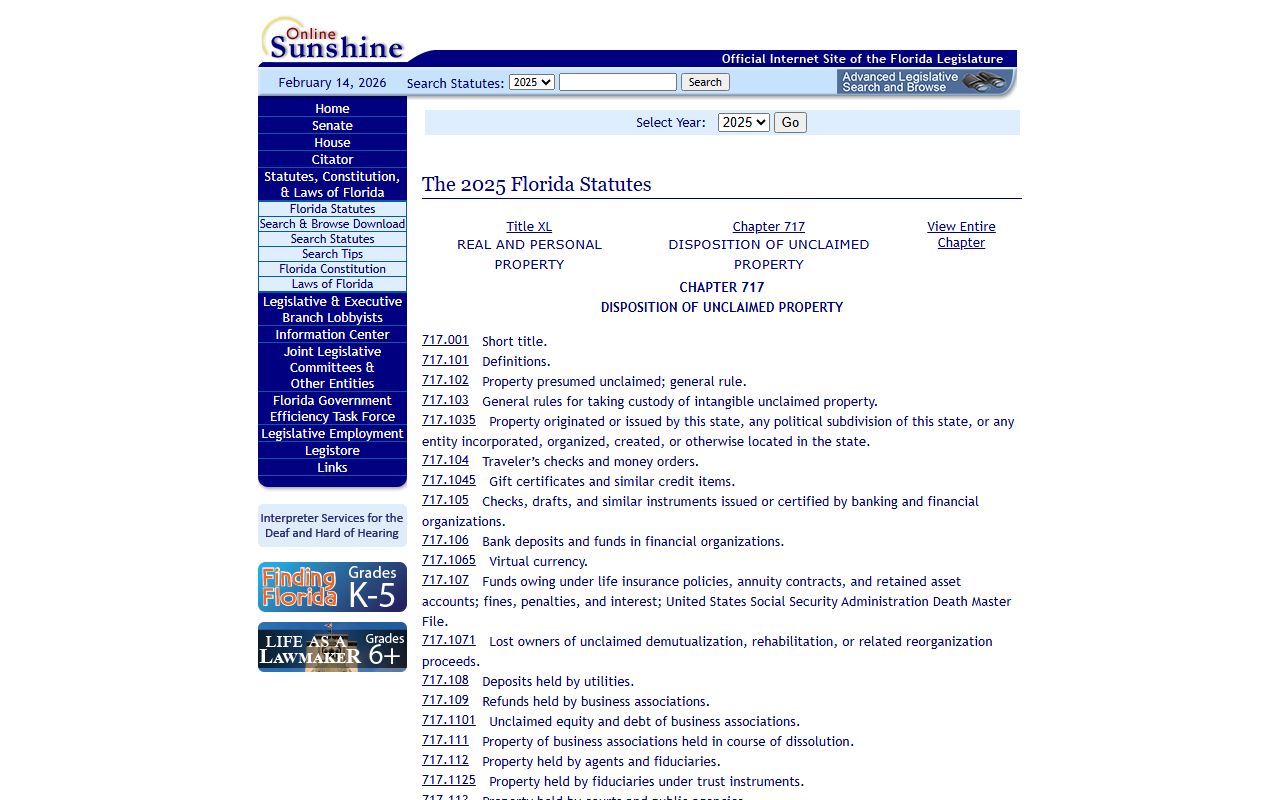
Section 717.117 requires every holder of unclaimed property to submit a report to the Department by May 1 of each year. Section 717.129 makes clear that no time limit can stop unclaimed money from being turned over to the state. Even if a contract or statute sets an expiration date, the funds still go to the Department. The Administrative Rules under 69G-20 cover claims processing, required documents, the appeals process, and record retention. These rules work with the statute to protect both owners and the state.
Other Florida statutes touch on unclaimed funds too. Section 116.21 covers unclaimed court-related money held by county clerks. Section 733.816 addresses unclaimed funds in the hands of a personal representative during probate. Section 744.534 deals with unclaimed funds held by a guardian. All of these feed into the broader system for handling unclaimed money in Florida.
Note: There is no statute of limitations on unclaimed property claims in Florida. You can claim your money at any time.
Claim Your Florida Unclaimed Money
Filing a claim costs nothing. Start at fltreasurehunt.gov and search for your name. When you find an account, the site walks you through how to begin. You get a claim form that lists the steps and documents you need. Read the form with care. Fill it out all the way and sign it. Each claim form spells out what proof you must send.
The state needs proof that you own the account. Having the same name is not enough. Many people share names, and the Department often gets more than one claim for the same funds. You must send documents that prove the account belongs to you. Florida law requires a copy of your driver's license or another government-issued photo ID. If your ID does not show your current address, include a current utility bill or other mail that shows where you live now. For a deceased owner, you need a certified death certificate plus ID for all heirs claiming the funds. The Department reviews each claim and its documentation before making a decision on your unclaimed money.
To claim unclaimed money in Florida, you will typically need:
- Government-issued photo ID showing your current address
- Proof of ownership linking you to the account
- Signed claim form from the Department
- Certified death certificate if the original owner has passed away
- Heir documentation if claiming on behalf of an estate
Mail your completed claim form and documents to P.O. Box 8599, Tallahassee, FL 32314-8599. The Department has up to 90 days from the date it gets your full claim package to make a decision. Claims often get done sooner. But the full 90 days may be needed when volume is high. Do not call before that time has passed. You can check your claim status at the claim status page on the state site.
Watch out for scams when dealing with unclaimed money in Florida. The Department will not text you about a claim. If someone contacts you about unclaimed property, check through the official site first. The search and claims process is always free. No one should charge you a fee to search for or claim your own unclaimed money in Florida.
Note: Hand-written letters, business cards, and internet printouts are not accepted as proof of ownership by the Department.
County Unclaimed Funds in Florida
Florida's unclaimed property program runs mostly at the state level. But each county's Clerk of Courts may also hold unclaimed funds. These include court registry deposits, uncashed checks for jury pay or vendor work, tax deed surplus from property auctions, foreclosure surplus, and cash bonds. County clerks hold these funds for a set time. After about one year, the money gets sent to the state at fltreasurehunt.gov.
Under Section 116.21 of the Florida Statutes, any unclaimed court-related money collected by the Clerk must go into the Fine and Forfeiture fund. Some county clerks post lists of unclaimed funds on their websites. Brevard County, for example, runs a detailed unclaimed funds page that lists refunds, tax deed surplus, and court registry money. Citrus County publishes a list in the Citrus County Chronicle each July and accepts claims through an unclaimed money affidavit. Pinellas County keeps an unclaimed monies page covering everything from probate registry to mortgage foreclosure funds. Check your local clerk's site or call their finance office for details about unclaimed money in your county.
The resources page at fltreasurehunt.gov has more on how county and state systems work together to handle unclaimed funds in Florida.
Florida Unclaimed Money Resources
The Division of Unclaimed Property has three sections that handle different parts of the program. Claimant Services processes claims from people and businesses. Email them at FloridaUnclaimedProperty@MyFloridaCFO.com or mail your claim to P.O. Box 8599, Tallahassee, FL 32314-8599. The toll-free phone line is 888-258-2253. The Reporting and Compliance Section works with businesses to make sure they follow Chapter 717 requirements for turning over unclaimed funds. The Asset Management Section handles the custody and payout of all funds, stocks, and safe deposit box contents at 200 East Gaines Street, Tallahassee, FL 32399-0358.
Florida also runs outreach events around the state to help people search for and claim unclaimed money. These events give residents face-to-face help with the search and claim process. Staff can help you fill out forms and check if you have unclaimed funds on the spot. Check the events page for dates and locations near you.
If you are a business that holds unclaimed property, the holder reporting page has the forms and tools you need to file your annual report. Holders must submit their reports by May 1 each year under Section 717.117. The Reporting Section can be reached at EReporting@MyFloridaCFO.com or at P.O. Box 6350, Tallahassee, FL 32399-6350.
Search tips from the state: try all known names, including maiden names and nicknames. Check each state where you have lived or done business. Search for both your personal name and any businesses you have owned. The database at fltreasurehunt.gov is free and open around the clock for finding unclaimed money in Florida.
Browse Florida Unclaimed Money by County
Each county in Florida has a Clerk of Courts who may hold unclaimed funds. Pick a county below to find local details and resources for unclaimed money in that area.
Unclaimed Money in Major Florida Cities
Residents of Florida cities search for unclaimed money through the state database and their county clerk. Pick a city to find unclaimed money resources for that area.